

Technomag Inc. manufactures bonded ferrite magnets in various sizes and specifications. We meet the highest quality standards set by MMPA (Magnetic Materials Producers Association).
Applications
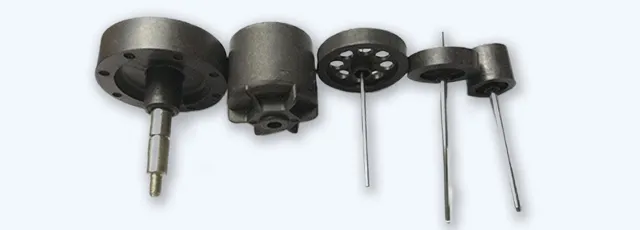
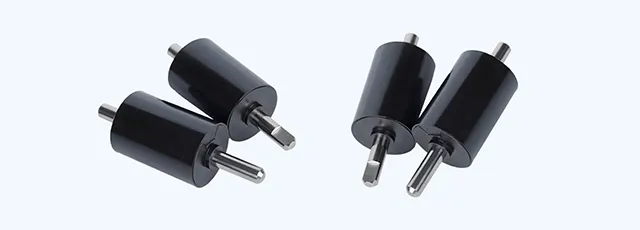
Bonded ferrite magnets are widely used across various industries due to their versatility and cost-effectiveness. Common applications include BLDC motor rotors, loudspeakers, and headphones, where they enable efficient performance and sound quality. They are also essential in office automation equipment, serving as magnetic rollers in printers and copiers, as well as in magnet rollers for copy machines. In consumer electronics, bonded ferrite magnets are utilized for compact and reliable magnetic components, while in household and industrial settings they are often employed in magnetic seals and gaskets. Additionally, they find use in magnetic buzzers, contributing to compact acoustic signaling devices.
Key Features
- Material Composition: Ferrite powder (hard magnetic particles) + polymer or rubber binder.
- Manufacturing Methods: Injection molding, compression bonding, extrusion, or calender rolling.
- Magnetic Strength: Lower than sintered ferrite magnets (because the binder reduces the proportion of magnetic material).
- Shapes & Complexity: Can be molded into thin-walled, intricate, or custom shapes that are difficult to achieve with sintered ferrites.
- Mechanical Properties: More flexible, tougher, and resistant to cracking compared to brittle sintered ferrite magnets.
- Magnetic Orientation: Can be isotropic (magnetizable in any direction) or anisotropic (higher performance, aligned during manufacturing).
Classification
Bonded ferrite magnets are classified as isotropic, anisotropic, or polar anisotropic based on the alignment of their ferrite particles during manufacturing, which determines their magnetic properties. Isotropic magnets have uniform, weaker properties in all directions because the particles aren’t aligned. Anisotropic magnets are stronger, with a preferred magnetization direction achieved by exposing particles to a magnetic field during manufacturing. Polar anisotropic magnets are a subset of anisotropic, where the particles are aligned to create specific multi-pole patterns for specialized applications like rotors.